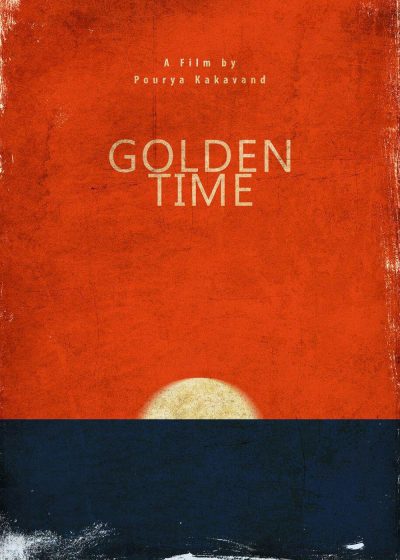
Synopsis
Golden Time is an episodic film that, across twelve segments named after the twelve months of the year, follows a series of different people converging on a single common point: all of them, in their cars, in that same fleeting moment of sunset when the golden, fading light falls across the scene, come face to face with a crisis in their lives. In this narrative, the car becomes a closed, interior space in which secrets spill out, fateful decisions are made, and people are confronted with the hidden version of themselves, or of others.
Farvardin
A script supervisor secretly involved with a famous actor shows him one of their private photographs on set and threatens that either they marry officially the next day, or she will release the photo online.
Ordibehesht
Away from his wife’s eyes, Mr. Maleki uses the services of a pimp named Amir, needing the money for his daughter’s school tuition. Leili, one of the girls Amir sends out, is terrified of the man she is about to meet and begs Maleki to stop it from happening.
Khordad
A single mother, together with her ten-year-old daughter, parks in front of her boyfriend’s house, hoping that seeing him will help mend their broken relationship. The daughter, worn down by her mother’s state of mind, plays a verbal game in which she takes on her mother’s role, and, throwing the reality of her mother’s life back at her, suggests that suicide would be the way out.
Tir
Shahab, whose wife has been in a coma for months, crosses paths with his old neighbor Kaveh on the way back from the hospital. Kaveh, who has recently handed over management of the building and is planning to emigrate, shows him a box of his wife’s keepsakes that he has secretly kept, and confesses that he has been quietly in love with her for thirty years.
Mordad
A girl who had her father imprisoned for domestic violence searches, as his release draws near, for single men planning to emigrate, hoping to convince one of them to marry her so he can take her out of Iran and save her.
Shahrivar
Maryam, a driving instructor, is teaching her student Mahsa on the highway. Without explaining why, Mahsa parks the car at the exact spot where Maryam’s husband was killed in an accident a year earlier. When Maryam, puzzled by the choice of route, asks the reason, Mahsa confesses, out of guilt, that she was the driver in that same accident.
Mehr
A group of students and their professor are traveling by bus into the desert on a research trip. The students discover that the reason one of their female classmates did not come is that the professor assaulted her. Now is the best moment to take revenge on him.
Aban
After her husband’s brain death, a woman donates his organs in an act of charity, on the condition that she be present at the moment each organ is taken. When the head nurse objects, she admits that she made this decision out of hatred for her husband, and secretly hopes that watching his body be taken apart piece by piece will finally bring her peace.
Azar
A young married couple who deal drugs, cruise the city in their car disguised as a bride and groom, selling drugs, until they come across a young addict who has cut off his mother’s finger and stolen her gold ring to pay for his habit.
Dey
Simin, suspicious that her husband is having an affair, has planted a listening device in the house and discovers that his mistress, Sahar, is planning to take her own life. Now she is caught between saving the girl and letting her die.
Bahman
Four sisters, together with their brother Majid, set off for a neighboring village to ask for a young woman named Faezeh’s hand in marriage on behalf of their elderly father. But before they arrive, they discover that their brother has been in love with her for years.
Esfand
Two brothers and a sister, who for years since their parents’ death have cared for their mentally disabled brother Hassan, decide, as it has come to disrupt their own lives, to drown him at sea. To choose which of them will carry out the task, they draw lots.
Director's Statement
Golden Time is an episodic film in twelve acts; twelve stories across the twelve months of the year, all converging on a single common point: a car, in that brief, fleeting moment of the Golden Hour, when the day’s golden light is fading toward dark.
Each episode unfolds in a single continuous shot, and everything within it takes place inside a narrow window of time. This constraint is part of the film’s structure and its meaning. Just as the light of sunset holds its state for only a short while, the characters in each episode have only a limited window in which to decide. Decisions that most often waver between morality, self-interest, love, revenge, survival, and responsibility.
The car in this narrative is not simply a location. It is a closed, temporary space that separates people from the ordinary flow of their lives and places them in a position from which they can no longer easily escape the consequences of their own decisions. Within this confined space, secrets come to light, relationships shift, and people are confronted with parts of themselves, or of others, that had until then remained hidden.
The film’s twelve stories follow people from different social backgrounds; ordinary people who suddenly find themselves in extraordinary circumstances and are forced to make a difficult choice. For me, this is where drama takes shape: the moment when a person must choose between what they want and what they know is right.
But these choices do not happen in a vacuum. Economic and social conditions can act upon a person’s morality, making the line between right and wrong harder to draw. When survival, security, money, or the future become everyday concerns, morality is no longer always a simple, costless choice.
In this film, I did not want to divide people into good and bad. I wanted, more than anything, to see what circumstances could drive a human being toward lies, violence, betrayal, revenge, or even sacrifice. I believe no one is a hero or a villain from the outset; in different situations, people can commit the most varied acts.
Golden Time is an attempt to look at human beings before we judge them, and to ask how far the conditions of a life can reshape our moral choices.
Cast & Crew
The Daughter began with a simple question: what happens when people lose not only their future, but even the right to dream of one? This film is not about infertility. It is about a couple who have reached a point where even the most natural wish of their lives, that is having a child, no longer seems possible. To escape this absence, they create a new reality; a reality that is, at first, their refuge, but gradually turns into a prison of their own making.
The Daughter who appears in the film is not real; yet the longing that brings her into existence is absolutely real. Throughout the film, “Sayeh” (meaning shadow) is not merely the name of a child, but becomes a metaphor for lost dreams. The change in aspect ratio, the use of shadows, and the gradual shift of colors of colors from warm to cold, are all attempts to draw the viewer into this transformation: a dream that initially expands the characters’ world, and ultimately imprisons them within itself.
For me, The Daughter was an attempt to trace the moment when the boundary between reality and imagination is no longer easily discernible; the moment when what we have constructed in order to survive, slowly begins to replace the real world.